Track Mower & Skid Steer Loader Manufacturer

Contact Us
Track Mower & Skid Steer Loader Manufacturer
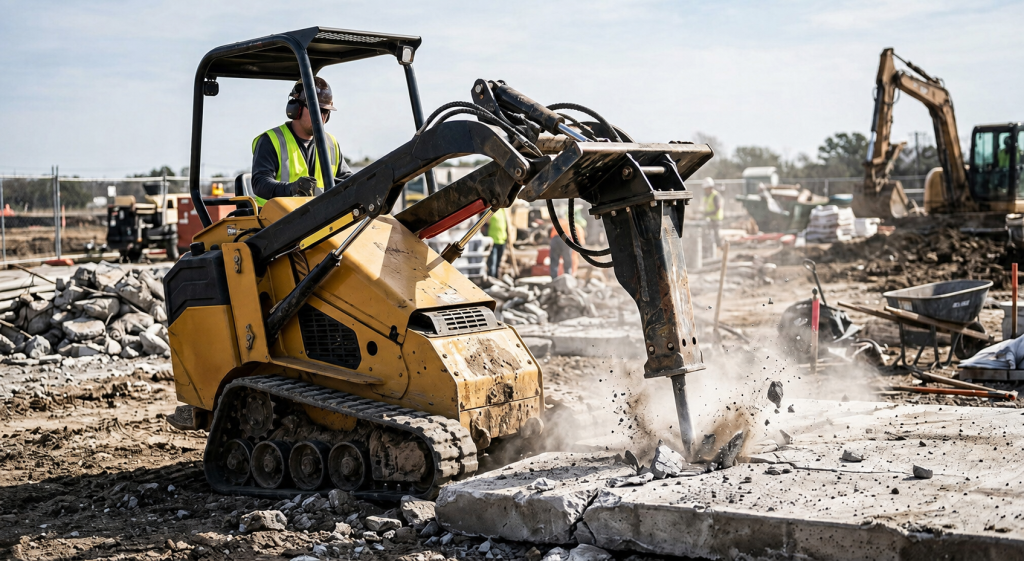
The right hydraulic breaker for a mini skid steer weighs roughly 6-10% of the carrier’s operating weight and matches the carrier’s rated flow within about 10-15%, not the biggest breaker that will physically bolt onto the quick-attach plate. Get the flow-to-pressure ratio wrong and you either starve the breaker (weak, slow strikes) or overpower it (blown seals, cracked tool bushings, a carrier that tips forward every time the chisel bites). Size it right and a 2,000-lb mini skid steer with an 80-100 lb breaker will out-produce a mismatched setup all day long — smaller machine, same tonnage broken.
Here’s a mistake we see constantly: a contractor buys the biggest breaker their auxiliary hydraulic couplers will physically accept, assuming more mass equals more production. It doesn’t work that way on a compact carrier.
A mini skid steer isn’t a full-size excavator with a heavy counterweight and a boom absorbing recoil. The breaker’s reaction force travels straight back through the arm and into the chassis. Oversize the tool and the carrier rocks, skips, or lifts on one side with every blow — energy that should be breaking concrete is instead bouncing the machine around. That’s lost production and accelerated wear on pivot pins, bushings, and the undercarriage.
Undersizing has its own penalty: a breaker rated for 12-15 GPM running on a carrier that only supplies 7 GPM will strike weakly and overheat the hydraulic oil, since excess pressure with insufficient flow just turns into heat at the relief valve.
Flow rate determines strike frequency — how many blows per minute the breaker delivers. Pressure determines the force of each individual blow. Most buyers fixate on pressure ratings and ignore flow, which is backwards.
Every breaker has a rated flow range, typically a 3-5 GPM window (for example, 9-13 GPM). Your carrier’s auxiliary hydraulic circuit needs to sit inside that window at working RPM, not just at idle. Check the spec plate or operator’s manual for your mini skid steer’s rated auxiliary flow — most compact units in the 1,800-2,500 lb class deliver 8-16 GPM depending on engine and pump configuration.
If your carrier only pushes 9 GPM and the breaker wants 14-18 GPM, you’ll get a sluggish, underpowered tool no matter how good the breaker is. That mismatch is one of the most common reasons buyers choosing a mini skid steer loader end up disappointed with attachment performance later.
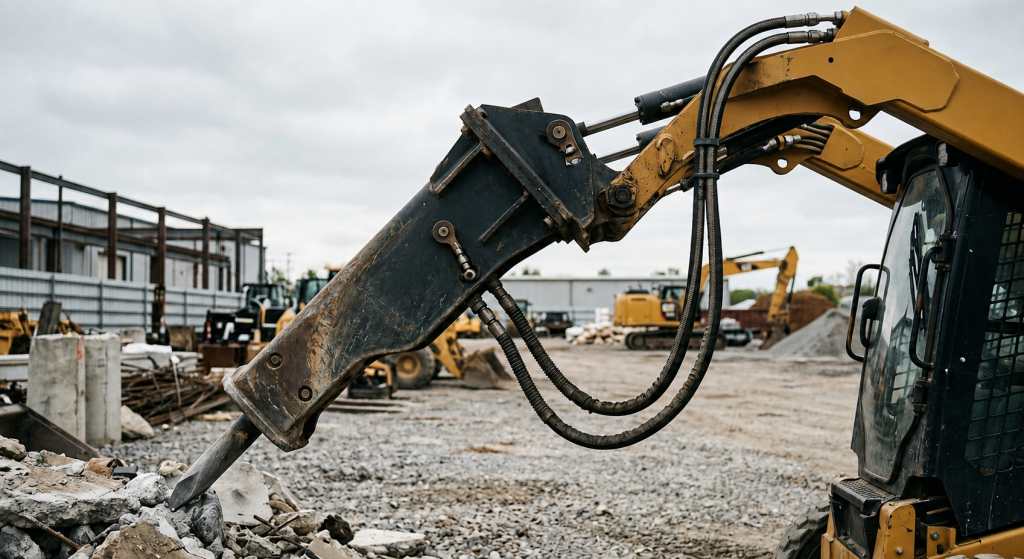
Most mini skid steer breakers operate in the 1,500-2,500 PSI range, but the number that actually protects your equipment is the carrier’s relief valve setting, not the breaker’s max-rated pressure.
If your carrier’s auxiliary circuit relief is set higher than the breaker’s tolerance, every stalled or jammed strike sends a pressure spike straight into the breaker’s seals and accumulator. Over time that shows up as leaking cylinders and premature nitrogen loss in the accumulator — an expensive repair that looks like a breaker defect but is really a carrier mismatch.
Rule of thumb: confirm the breaker manufacturer’s max inlet pressure exceeds your carrier’s relief setting by at least 10%. If it doesn’t, a flow divider or pressure-reducing valve in the circuit is worth the cost.
The most reliable sizing shortcut in the industry: breaker weight should equal roughly 6-10% of the carrier’s operating weight. A 2,200 lb mini skid steer should carry a breaker somewhere between 130-220 lbs, not a 300 lb unit meant for a machine twice its size.
Why this range and not a fixed number? Lighter carriers with more of their weight forward (tracked units, for instance) can tolerate slightly heavier tools than wheeled units of the same operating weight, because tracks distribute reaction force over a longer contact patch and resist tipping better. This is one of several reasons the track vs wheel skid steer decision affects more than just traction — it changes your attachment ceiling too.
A demolition subcontractor running a 2,400 lb tracked mini skid steer tried a 260 lb breaker to speed up footing removal on a residential job. The carrier lifted its front end on nearly every third strike, chipping concrete unevenly and wearing the front idler wheels fast. Swapping to a 180 lb breaker — right in the 6-10% window — eliminated the lifting entirely and actually cut job time, because the operator wasn’t constantly repositioning the machine.
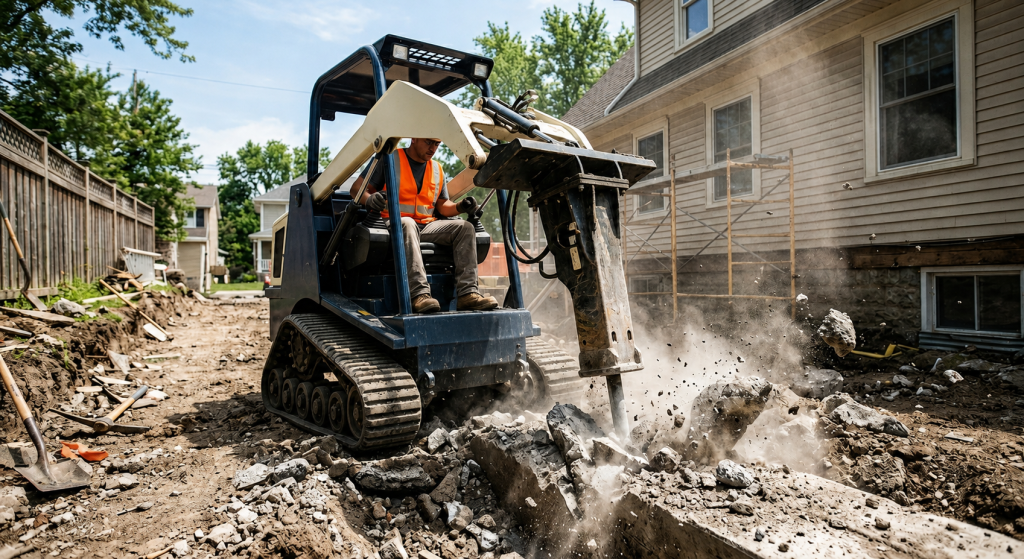
Tool diameter (the chisel or moil point width) affects energy transfer more than most operators realize. A wider tool spreads impact force over more surface area, which is correct for soft or already-fractured material but wasteful for hard, unbroken concrete or rock.
Running a narrow moil point on a heavy carrier concentrates too much energy in a small contact area and accelerates tool wear and bushing fatigue. Running a wide chisel on an undersized carrier wastes strike energy dispersing force the machine can’t fully deliver.
Two breakers can carry identical weight specs and still perform completely differently on the same carrier, because BPM (blows per minute) and joules per blow work against each other. High-frequency breakers (700-1,000+ BPM) deliver lighter, faster blows — good for softer, layered material like asphalt or fractured rock. Low-frequency breakers (400-600 BPM) deliver heavier, slower blows — better for dense, monolithic concrete and boulders.
A landscaping contractor clearing rock outcrops for a hardscape project doesn’t need the same breaker profile as a demolition crew breaking 12-inch structural footings, even if both carriers weigh the same 2,300 lbs. Ask your dealer or OEM for the BPM spec, not just weight and flow, if your work involves dense or reinforced concrete.
Reputable manufacturers pair breakers with specific carrier weight classes for a reason — they’ve tested the flow, pressure, and reaction-force combination rather than relying on a generic spec chart. When Anqun configures breaker compatibility for our mini skid steer line, we match hydraulic circuit output to the attachment’s rated flow window and confirm relief valve settings before it ships, so buyers aren’t left guessing or running third-party breakers that were never validated against the carrier’s pump curve.
This matters most for export buyers who can’t easily test-fit attachments before shipping. Confirming flow, pressure, and weight compatibility on paper, backed by real application data across landscaping, construction, and forestry use cases, avoids a container arriving with equipment that simply doesn’t work together.
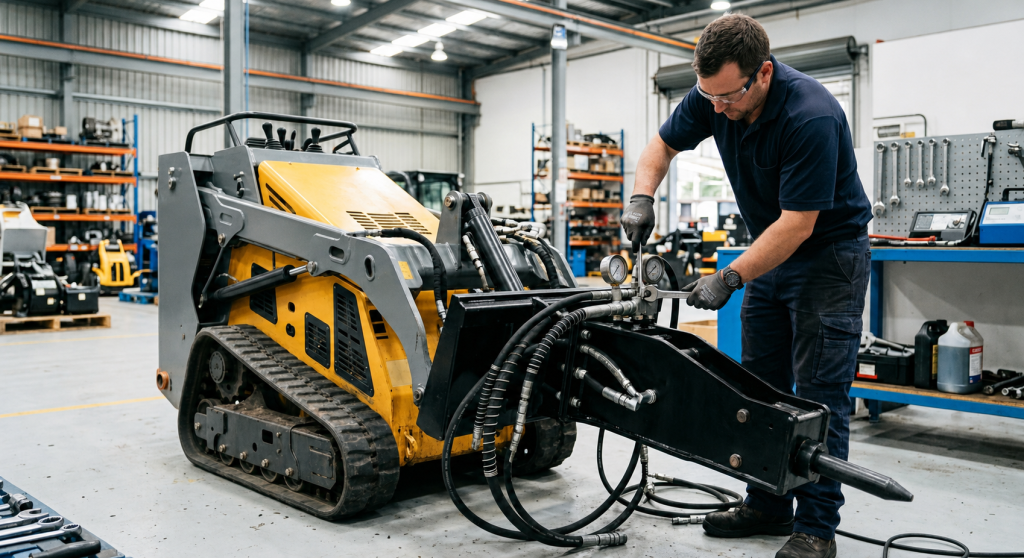
Before ordering a breaker for your mini skid steer, run through this in order — skipping steps is how mismatches happen:
If you’re still narrowing down which carrier to pair attachments with in the first place, our guide on popular skid steer choices based on how they’re used breaks down carrier classes by job type before you even get to attachment sizing.
 Guides
 Guides
 Guides
 Guides
 Guides
 Guides