Track Mower & Skid Steer Loader Manufacturer

Contact Us
Track Mower & Skid Steer Loader Manufacturer
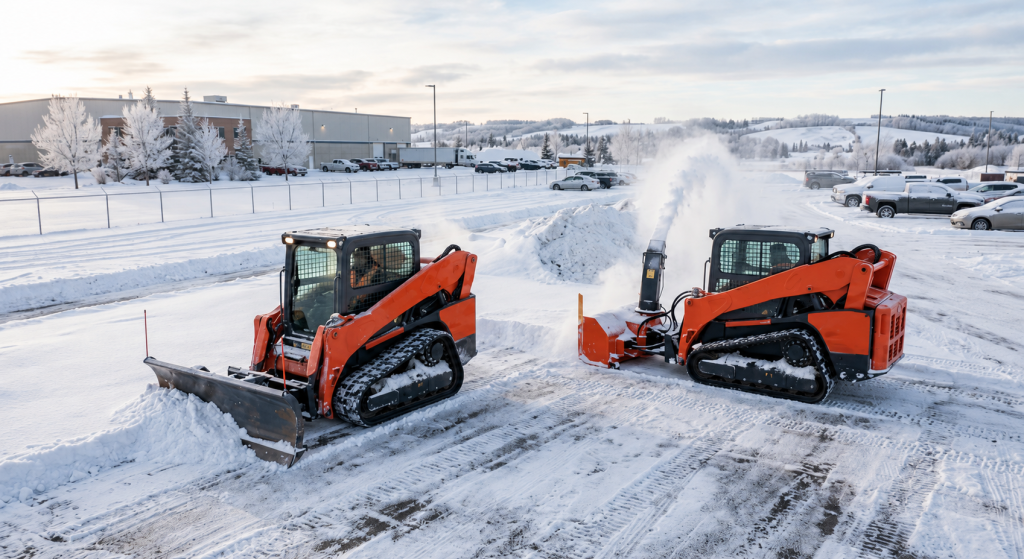
Pick a plow if you’re clearing large open areas fast and have room to pile snow at the edges. Pick a blower if you’re working narrow sidewalks, tight urban paths, or spaces where there’s simply nowhere to push the snow. The real deciding factors are snow depth, surface width, and where the snow needs to go — not which attachment sounds tougher.
Most buyers start by asking about horsepower or blade width. Wrong starting point. The first question should be: once this snow moves, where does it actually go?
A plow pushes snow forward and to the side. That means you need somewhere for it to pile — a wide shoulder, an open field edge, an empty corner of a lot. Try plowing a narrow sidewalk lined with fences on both sides and you’ll just build a snow wall that blocks the path within three passes.
A blower solves that problem by throwing snow 15 to 30 feet away, depending on chute angle and snow density. No piling, no wall-building. That’s why property managers running tight condo walkways almost always end up with a blower, while landscaping crews clearing commercial lots stick with plows.
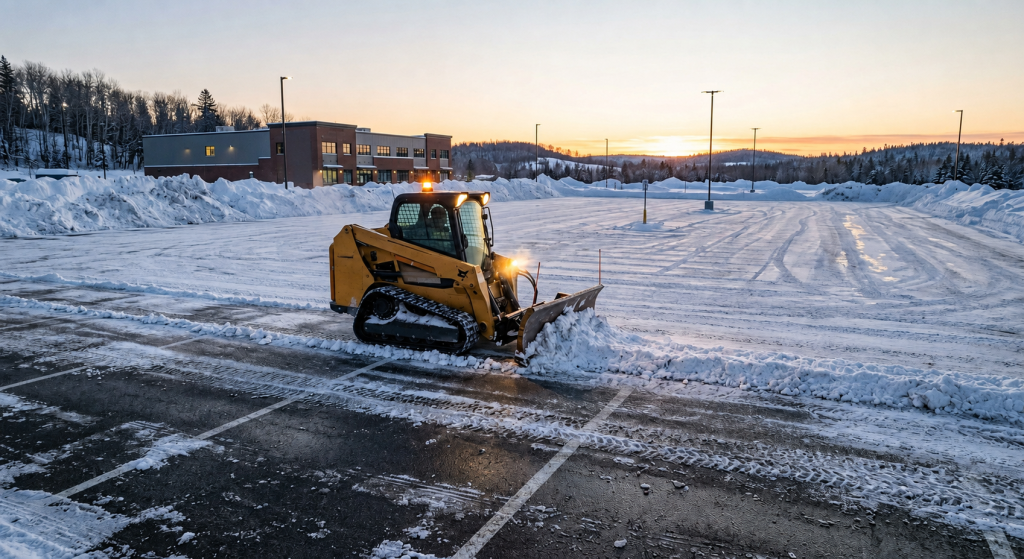
Here’s a number worth remembering: 8 inches. Below that, a plow on a mini skid steer will out-clear a blower every time — it’s faster and needs less setup. Above 12-14 inches of dense or wet snow, plows start struggling. The blade rides up, the machine loses traction, and you end up making multiple passes anyway.
Blowers don’t care much about depth. A two-stage auger attachment chews through 18+ inches without much trouble, as long as the machine has the hydraulic flow to keep the auger spinning under load. The tradeoff is speed — a blower pass through deep snow is noticeably slower than a plow blade skimming across a lighter dusting.
Dry powder is forgiving for both attachments. Wet, heavy snow — the kind that packs into slush — is where plows lose their advantage fast. It doesn’t slide off the blade cleanly, it smears and compacts. Blowers handle wet snow better structurally, but expect reduced throw distance, sometimes down to 8-10 feet instead of 20+.
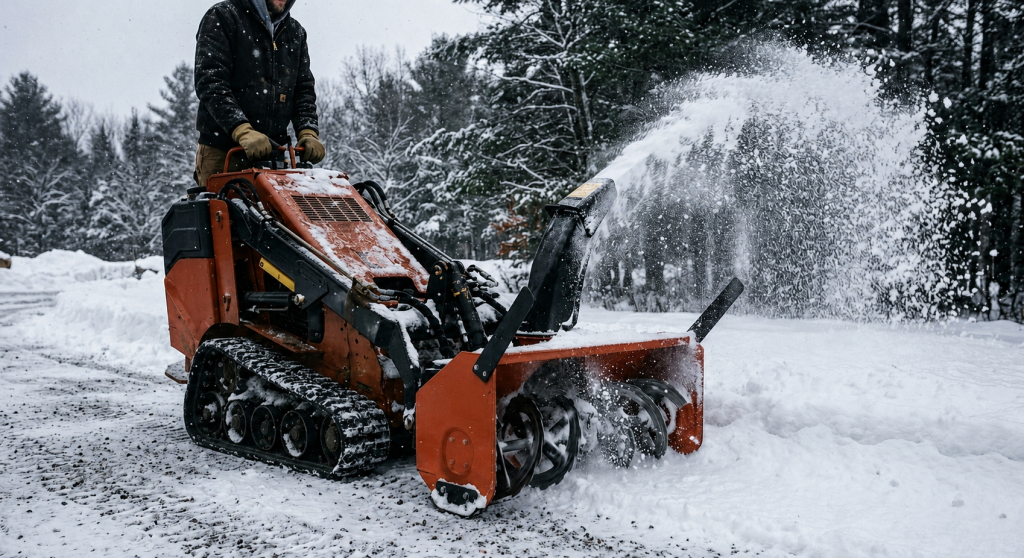
A property management firm servicing a mixed portfolio — apartment complexes, small retail plazas, and HOA neighborhoods — ran both attachments for two winters before settling on a split fleet. For the retail plaza parking lots, a plow-equipped mini skid steer cleared each lot in under 20 minutes. For the HOA sidewalks and narrow walkways between buildings, a blower attachment on a second unit handled the job without piling snow against resident doors or fences.
The lesson here isn’t “buy both” necessarily — it’s that job geometry decides the tool, not personal preference. If your work is mostly wide-open surfaces, don’t overspend on a blower you’ll rarely need for its throw distance. If you’re boxed in by fences, curbs, or building walls, a plow will just create more problems than it solves.
Plows are mechanically simple — a blade, a moldboard, a mounting frame, sometimes a trip edge for hitting curbs without damage. That simplicity keeps prices low, typically $800 to $2,500 depending on width and whether it’s angled or straight. Maintenance is mostly replacing the cutting edge once or twice a season.
Blowers are a different animal. You’ve got an auger, a gearbox, a chute rotation motor, and hydraulic demands that push many mini skid steers close to their flow limits. Expect $3,000 to $7,000 for a quality unit, plus more frequent maintenance — shear pins, auger bearings, chute cable adjustments. If your machine’s hydraulic system isn’t rated for the auger’s flow requirements, you’ll burn through components fast.
Before buying either, check your mini skid steer’s hydraulic specs against the attachment manufacturer’s minimum flow rating. This is the single most common mismatch that leads to premature attachment failure.
Gravel driveways and plows don’t mix well. A straight-blade plow set too low will scoop gravel along with the snow, and now you’re re-spreading your own driveway material every spring. Blowers are gentler on loose surfaces since the auger height can be set to skim just above the gravel line.
Pavers and decorative concrete are another case where plows risk chipping edges, especially with a rigid blade that doesn’t float over uneven joints. If your job sites include a lot of paver walkways — common in property management and upscale landscaping contracts — a blower attachment protects the surface investment your client already made.
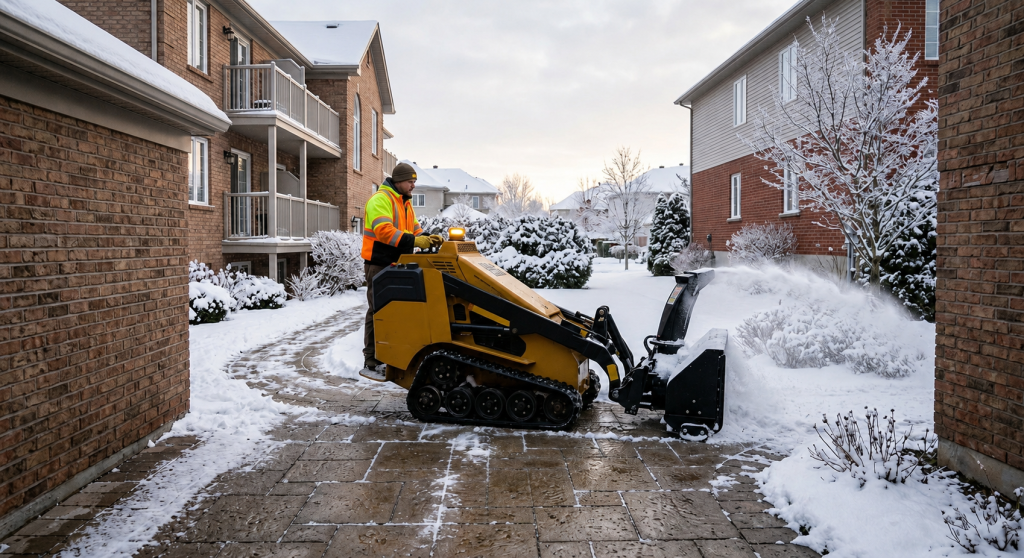
Not every mini skid steer can run a full-size blower. The auger and gearbox add real weight up front, and if your machine’s lift capacity and hydraulic flow are on the lower end, you’ll be underpowering the attachment — meaning slower auger speed and reduced throw. Check the attachment’s rated hydraulic flow (GPM) against your machine’s actual output before committing.
Plows are far more forgiving on machine size since they’re passive tools relying on hydraulic angle/tilt functions rather than continuous power draw. Nearly any mini skid steer loader with standard quick-attach plates can run a plow without straining the system.
If you’re still deciding between machine platforms before adding a winter attachment, it’s worth reviewing how to choose the right mini skid steer loader for your business — hydraulic flow specs matter just as much for summer attachments as they do for winter ones.
A plow blade is basically dead weight from April through October unless you swap it for a grading or dozer blade setup — some units do double duty. A blower has almost zero off-season use; it’s a single-purpose tool sitting in storage for eight months.
This is where a lot of buyers get the math wrong. They compare sticker prices without factoring utilization. If your fleet already runs track or wheel skid steers for landscaping and grading work most of the year, the marginal cost of adding a plow is low — you’re just buying an attachment for a machine that’s already earning its keep. Adding a blower is a bigger standalone investment that needs to be justified by winter contract volume alone.
If most of your winter contracts are open lots, driveways, and roads — buy the plow. It’s cheaper, simpler, faster on the surfaces you’re working, and easier to maintain. If your work leans toward narrow paths, sidewalks, or surfaces where piled snow becomes a liability, the blower earns its higher price tag.
Running both surface types regularly? Many contractors keep a plow on their primary machine and rent or buy a blower attachment seasonally rather than owning both outright year-round. That keeps capital tied up in equipment that’s actually working, not sitting in a shed.
 Guides
 Guides
 Guides
 Guides
 Guides
 Guides